- (+84) 86 696 0800
- htdn@tpm.com.vn
- 102 Phung Van Cung Street, Cau Kieu Ward, Ho Chi Minh City

- (+84) 86 696 0800
- htdn@tpm.com.vn
- 102 Phung Van Cung Street, Cau Kieu Ward, Ho Chi Minh City
Archives
- October 2026
- September 2026
- July 2026
- June 2026
- May 2026
- April 2026
- March 2026
- February 2026
- January 2026
- December 2025
- November 2025
- October 2025
- September 2025
- August 2025
- July 2025
- June 2025
- May 2025
- April 2025
- March 2025
- February 2025
- January 2025
- December 2024
- November 2024
- October 2024
- September 2024
- August 2024
- July 2024
- June 2024
- May 2024
- April 2024
- March 2024
- January 2024
- November 2023
Categories
Electronic Temporary Exit Suspension: A Breakthrough Step In Tightening Tax Discipline
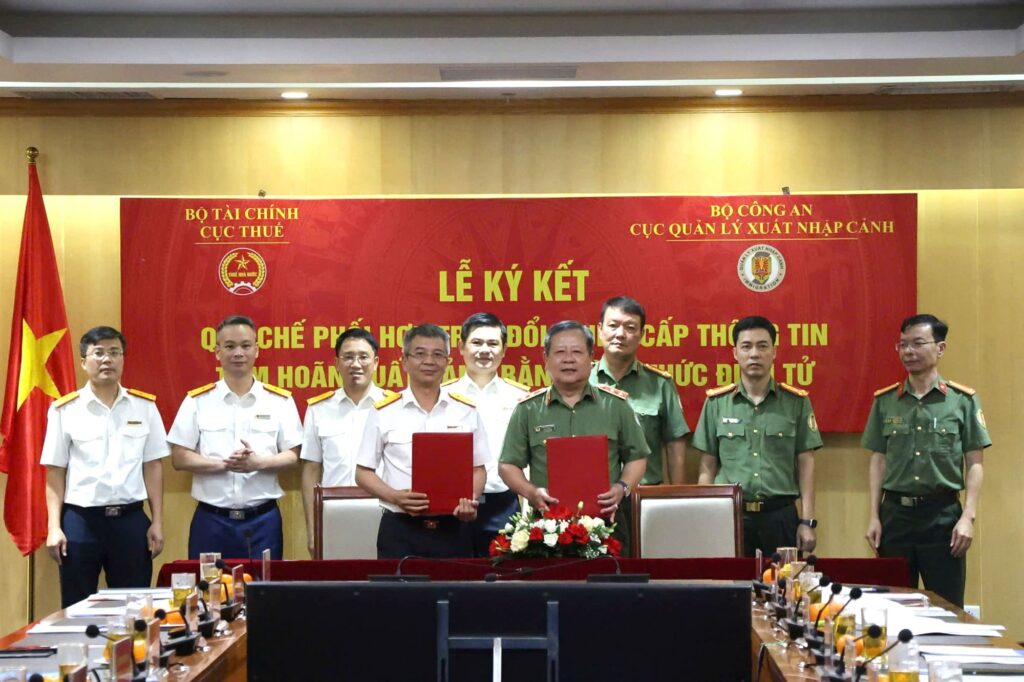
On the afternoon of May 12th, a significant event took place, marking a major step forward in tax and immigration management in Vietnam. This was the Signing Ceremony of a Coordination Regulation for the electronic exchange and provision of temporary exit suspension information between the General Department of Taxation (under the Ministry of Finance) and the Immigration Department (under the Ministry of Public Security).
The event was attended by high-level leaders from both sides: representing the Immigration Department were Lieutenant General Pham Dang Khoa – Director, along with representatives from the Department’s leadership board and professional divisions; representing the Ministry of Finance was Mr. Nguyen Minh Ngoc – Deputy Director of the Department of Information Technology; representing the General Department of Taxation were Mr. Mai Xuan Thanh – Director General, along with representatives from the Department’s leadership board and professional boards.
At the ceremony, Mr. Mai Xuan Thanh, Director General of the General Department of Taxation, affirmed: “Electronic coordination of temporary exit suspension information is an important step in assisting taxpayers fulfill their tax obligations before exiting the country.”
Strengthening Tax Discipline In The Integrating Economy
In the context of integration and socio-economic development, tax management has continuously improved in terms of institutions, operations, and technology. However, there still exists a segment of taxpayers who intentionally delay or evade financial obligations to the State. Notably, some cases involving large tax obligations or signs of violations have sought to exit the country to avoid responsibility.
Given this reality, there is a requirement to strengthen tax enforcement measures in a focused, lawful, and situation-appropriate manner. The Tax sector has actively reviewed and applied suitable legal tools to protect financial discipline and ensure state budget revenue. In recent years, alongside the comprehensive implementation of management measures under the Law on Tax Management No. 38/2019/QH14, Decree No. 49/2025/ND-CP, and guiding documents, the Tax sector has promoted the application of temporary exit suspension measures to taxpayers (individuals and organizations) who have not fulfilled their tax obligations, and this has initially yielded many positive results.
Initial Effectiveness Of Temporary Exit Suspension Measures
The application of temporary exit suspension measures under the Law on Tax Management No. 38/2019/QH14, Decree No. 49/2025/ND-CP, and guiding documents has initially achieved positive results.
To date, tax authorities at all levels have issued 61,492 temporary exit suspension notices with a total outstanding tax amount of up to 83,028 billion VND. Among these, 36,646 taxpayers abandoned their business addresses, with an outstanding tax amount of 13,407 billion VND.
More importantly, tax authorities have collected 4,955 billion VND from 7,309 taxpayers currently under temporary exit suspension. Specifically for the group of taxpayers who abandoned their business addresses, 256 billion VND has been collected from 2,694 taxpayers.
Challenges From Traditional Methods And The Requirement For Digital Transformation
Despite the initial effectiveness achieved, sending temporary exit suspension notices through traditional administrative methods (paper official letters, express delivery) still has limitations such as:
- Delays in processing time.
- Lack of data processing synchronization.
- Generation of unnecessary administrative costs.
These factors partially reduce the effectiveness of inter-agency coordination, causing difficulties in reviewing and handling tax obligations of organizations and individuals. Therefore, a flexible, modern, and technologically synchronized electronic information coordination mechanism is needed to maximize the role of temporary exit suspension as an effective, accurate, and highly deterrent legal tool within the modern tax management system.
Electronic Coordination: A Modern Solution Enhancing Management Effectiveness
The Signing Ceremony of the Electronic Coordination Regulation between the General Department of Taxation and the Immigration Department is precisely the timely answer to this pressing requirement. This is a concretization of a close coordination mechanism regarding legal aspects, technology, and responsibility, where data is not just numbers but also solid legal grounds to:
- Ensure strict enforcement of tax policies.
- Protect the interests of the State.
- Protect the legitimate rights of law-abiding taxpayers.
Commitment To Coordination, Ensuring Information Security
Speaking at the ceremony, Lieutenant General Pham Dang Khoa – Director of the Immigration Department, highly appreciated the coordination by the General Department of Taxation in providing information and data to the Public Security sector. The Director of the Immigration Department emphasized that the signing ceremony is an achievement of the serious implementation of the Government’s Decree No. 49/2025/ND-CP. It also strongly demonstrates support for the Government’s policy on digital transformation in state management activities. Especially, Lieutenant General Pham Dang Khoa also noted that during the operation of the electronic system, the highest requirement is to ensure the security, safety, and confidentiality of information, as this is a priceless national asset.
Following this, Mr. Mai Xuan Thanh, Director General of the General Department of Taxation, affirmed that after the signing ceremony, the two agencies will urgently implement the contents of the Coordination Regulation regarding the electronic exchange and provision of temporary exit suspension information. Accordingly, focal points such as the Tax Operations Board, Technology, Digital Transformation, and Automation Board (General Department of Taxation) will continue to coordinate closely with the Immigration Department to ensure seamless electronic system connectivity, timely troubleshooting, and information security according to regulations.
The head of the Tax sector also added regarding future plans: “In the coming time, the General Department of Taxation will continue to coordinate with the State Treasury and the commercial banking system to electronically transmit and receive tax payment information, aiming to shorten the time for confirming tax obligation fulfillment, promptly lift temporary exit suspension orders, and facilitate taxpayers.”
An Important Step For State Management And The Business Environment
This Electronic Coordination Regulation takes effect immediately upon signing. It can be affirmed that the signing of the Coordination Regulation between the General Department of Taxation and the Immigration Department is a concrete step in implementing the policy to strengthen inter-agency coordination in state management, contributing to the completion of institutions and enhancement of tax policy enforcement effectiveness. Based on the signed regulation, the sharing, processing, and using of temporary exit suspension information will be conducted entirely electronically, creating maximum favorable conditions for management agencies in identifying subjects and applying tax enforcement measures lawfully, promptly, and more effectively than ever before.
The implementation of this model also demonstrates the efforts of the Tax sector and the Public Security force in concretizing the Government’s digital transformation orientation, linking IT application with ensuring budgetary discipline and building an equal, transparent business environment. This is an important foundation for continuing to replicate coordination models among state agencies, aiming towards building a modern, integrity-driven public administration serving the people.
-
Vietnam Achieves Investment-Grade Credit Rating For The First Time From R&I
-
International Institutions Raise Positive Outlook For Vietnam’s Economic Growth In 2026
-
Ready-Built Factories Outpace Industrial Land, Attracting More Than USD 7 Billion In New Manufacturing FDI To Vietnam
-
German Businesses Accelerate Investment In Vietnam’s Green Hydrogen Sector
-
First Eight Months Of 2026: FDI Inflows Into Vietnam Surpass USD 40 Billion
-
Tax registration and tax declaration for individual business (“IB”) selling goods via Shopee in Vietnam
-
Newest Regional Minimum Wage In 2025
-
Trade Agreements (CPTPP, EVFTA, RCEP) Impact On FDI Enterprises
-
From July 1, 2025: Non-Salaried Business Managers Required To Participate In Mandatory Social Insurance
-
Property Rental Tax Obligations: New Regulations, Declaration & Updated Rates 2025-2026


TPM is proud to be an agency that provides full and excellent services in accounting, tax, HR & advisory services in Vietnam in nowadays business finance market.
Contact Us
TPM TAX AGENCY & CONSULTING CORPORATION
Tax Number: 0312787706
Feel free to contact & reach us!
Address: 102 Phung Van Cung Street, Cau Kieu Ward, Ho Chi Minh City
Email : htdn@tpm.com.vn
Hotline : (+84) 86 696 0800